

Identifying Behavior Patterns That Trigger Bookmaker Restrictions
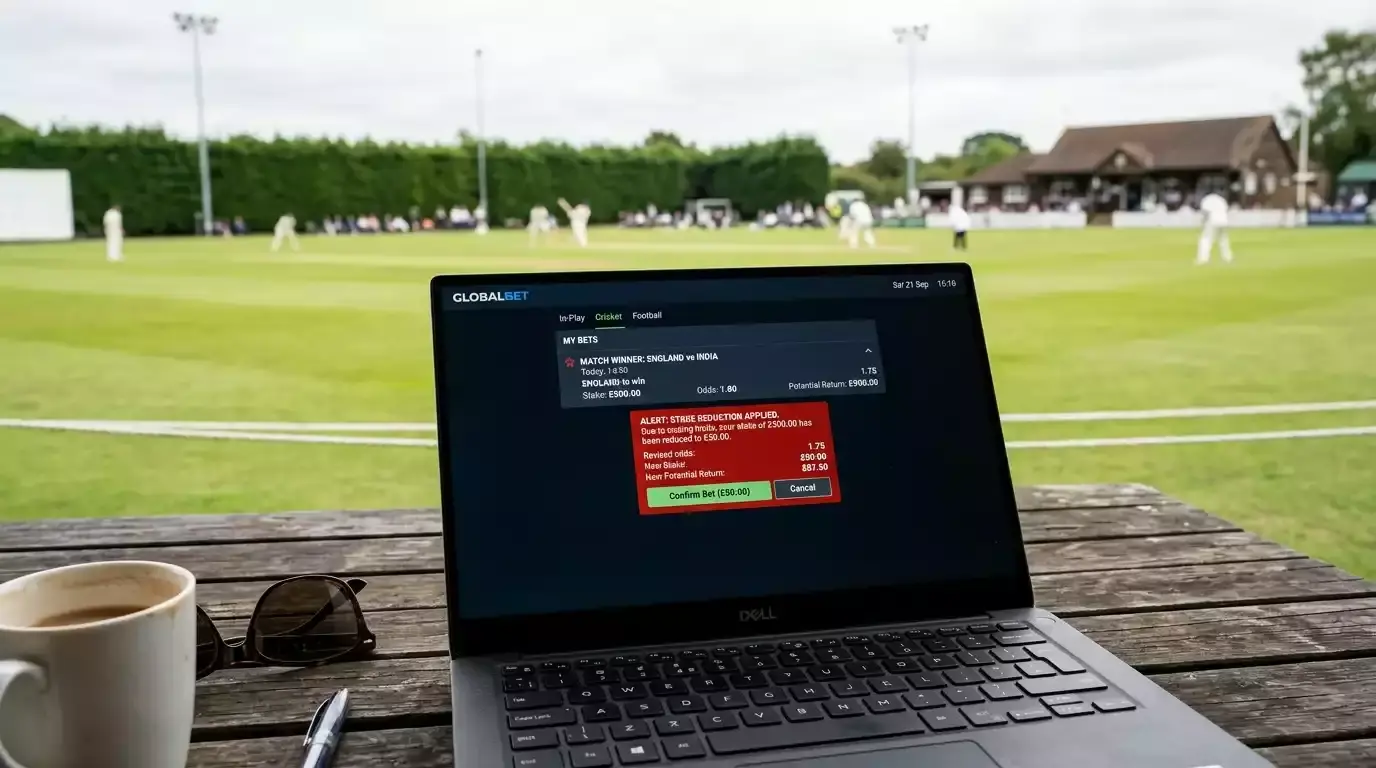
I had my main UK account stake-factored on a Tuesday afternoon in June. The bet that triggered it was £40 on a Bangladesh-Sri Lanka ODI, second-innings total over 247, placed twenty minutes before the start. Nothing exotic. Nothing late-money. The stake limit on my account went from “whatever I want” to “£3.40 maximum” on every cricket market the following week. I called customer service; they confirmed nothing, refused everything, and offered no path back.

That experience is the rule, not the exception. With UK online betting GGY at £2.6 billion in FY 2024/25 and a regulated sector under pressure on every margin point, books have refined their stake-factor systems into something like an industrial process. Cricket triggers those systems faster than most sports for reasons that say a lot about where books believe their exposure sits.
How Stake Factor Works on UK Sportsbooks
Stake factor is the multiplier the book applies to the published maximum stake on a market, on a per-account basis. The book might list £5,000 max stake on a Test match-winner market. A new account from a typical recreational profile gets a stake factor of 1.0 — they can have the full £5,000. An account that’s been flagged as sharp might have a stake factor of 0.001, meaning they can have £5 of that £5,000.

The factor isn’t a single number across an account. It varies by sport, by market type, by time-to-event, by your recent betting pattern. The same account might have a 1.0 factor on football match-winner markets and a 0.001 factor on cricket player props. Books apply the factor algorithmically based on signals — your closing line value on previous bets, your win rate against the book’s “true” pricing model, your stake distribution across favourites and underdogs, your patterns around line moves.
The painful part is that the factor change is silent. You won’t get an email. You’ll just notice that your usual £100 stake suddenly gets the “maximum stake exceeded” message at £8.50. UKGC operating licences don’t require books to explain stake factor decisions, only to apply them consistently within their published terms.
Why Cricket Markets Get Sharpened Up Quicker Than You Think
Cricket is high-information for sharps. The volume is huge — Sportradar’s product page describes over 7,000 pre-match and live cricket matches a year on their odds feed — but the per-market liquidity at sportsbook level is often modest compared to football. That combination means a single sharp account placing well-timed bets can move books materially, and books spot the pattern faster than they would in markets where stake volume is heavier and noisier.

Three signals trigger cricket-specific restrictions. The first is betting niche markets where the book’s pricing is shakiest — top batsman by position, player props, method-of-dismissal. The book knows these markets have wider true margins, but it also knows that sharps target them specifically because the per-market overround is high enough to support a real edge. Any account that concentrates action on niche markets gets flagged earlier than one that spreads across match winners.
The second is betting line moves. If you consistently place bets on prices that subsequently shorten — meaning you got better-than-average prices on positions that the market then validated — you’re exhibiting positive closing line value, and books care about CLV more than they care about win-loss record. CLV is the proxy for “is this account beating us in the long run, regardless of recent variance”.
The third is overnight or pre-news betting. Books leave cricket markets open longer overnight than they do football, partly because the operations cost of an active trader desk isn’t justified for thinner books, and partly because international cricket runs on a non-UK timezone. A pattern of bets placed in those windows — and consistently landing on the favourable side of the next morning’s repricing — is one of the cleanest tells of an information edge.
Arbitrage Between Sportsbook and Exchange: Mechanics and Margins
Arbitrage in cricket usually means backing on a sportsbook at one price and laying on a UK exchange at a shorter price, locking in a small return regardless of result. The mechanics are clean. The execution is harder than it sounds.

A typical cricket arb opportunity might look like this: sportsbook A has team X at decimal 2.30 in match-winner. The UK exchange shows lay price for team X at 2.20. Back £100 at 2.30 on the sportsbook, lay £105 at 2.20 on the exchange. If X wins, you get £130 back from the sportsbook minus the £105 you risked laying, a net profit of around £25 minus exchange commission. If X loses, you lose £100 on the sportsbook and win £105 (minus commission) on the exchange lay. Either way the position is profitable, after fees, in the low single-digit percentages.
The problem is that those margins are tiny, the opportunities are short-lived, and every successful arb leaves a footprint on your sportsbook account that gets you closer to stake factor reduction. The mathematics of pure arb against a UKGC sportsbook is a race between your bankroll growth and your account longevity. The accounts that last are the ones that mix arb bets with “cover” bets that look recreational — bad lines, sub-favourites, occasional acca slips. The book’s algorithm reads the pattern, not the individual bet.
Behaviour Patterns That Buy You More Time on an Account
I run my main account differently to the way I’d run a sharp account. The first rule is bet timing. Sharps place bets at line opens or after specific news; recreational accounts bet across the day, often closer to event start. If you want to keep an account, place most of your bets in the recreational windows — evenings, weekend mornings, post-toss windows.

The second rule is bet diversity. Books read concentrated action on niche markets as a sharp signal. Spreading bets across match winners, occasional accas, and the odd in-play single dilutes the signal. A 30 percent acca slip every now and then signals “entertainment punter”, even if your main slips are sharp.
The third rule is stake variance. Books look at stake patterns across your action. Consistent £100 flat stakes on every bet is a giveaway — recreational punters vary stakes, often inflating them on hot streaks and reducing them after losses. Mimic that variance deliberately.
None of these is a fix. They buy time. Eventually, if your CLV is genuinely positive, every UKGC sportsbook will catch up and stake-factor your account. The question is whether you’ve extracted enough value across the active period to justify the effort. For most punters running modest stakes in cricket markets, account longevity is more valuable than per-bet edge, and the optimal strategy is to keep the recreational mask on for as long as possible.
The natural alternative when sportsbook accounts get restricted is to migrate volume across to a UK exchange — and the mechanics of how those markets work is the subject of my piece on cricket exchange betting and the liquidity picture.
