

UK Cricket Betting Market Dynamics and Bookmaker Offers
Eight years into modelling T20 markets for a living, and I still keep one number pinned above my desk: £7.8 billion. That is what the UK remote gambling sector turned over in gross gaming yield in the financial year ending March 2025, a 13.1 per cent jump on the year before. Cricket is a sliver of that pie, but it is the sliver that has changed the most since the 2023 White Paper, the 2025 statutory levy, and the arrival of an independent Cricket Regulator at Lord's.
The picture in the UK right now is not the one most punters carry in their heads. The legal market has tightened, the offshore market has exploded, and the integrity data on cricket itself has more than tripled the noise of any year since 2021. That is the terrain this guide walks you across — with numbers in mono and opinions kept on a short lead.
£7.8bn
UK online GGY, FY 2024/25
1.1%
statutory levy on remote GGY from April 2025
9%
black-market share of UK online activity, H1 2025
1,116
suspicious matches flagged globally by Sportradar in 2025
The Six Numbers That Define UK Cricket Betting in 2026
- UK online gambling GGY hit £7.8 billion in FY 2024/25; online betting alone is worth £2.6 billion of that.
- The statutory levy at 1.1 per cent of online GGY, online slot stake limits, and £150/30-day affordability checks reshape the operator environment from 2025.
- Sportradar logged 59 suspicious cricket matches in 2025 — a sharp rise driven mostly by better detection, not a worse underlying problem.
- Offshore operators captured around 9 per cent of UK online activity in H1 2025; the legal margin of safety is narrower than it has ever been.
- Fractional to decimal: divide and add one. Decimal to implied: divide one by it. Two formulas, every day of the season.
Table of contents
- The 2024/25 Market in Numbers: GGY, Online Share, and Where Cricket Sits
- How UK Law Frames Cricket Betting in 2026
- Cricket Betting Markets: A Map of What You Can Actually Bet On
- Test, ODI, T20, The Hundred, Vitality Blast, County Championship: How Format Changes the Bet
- Reading UK Cricket Odds: Fractional, Decimal, Implied Probability
- Value, Edge, and Why Lower-Liquidity UK Markets Are Worth Watching
- In-Play, Cash Out, Micro-Bets: How Live Cricket Betting Works in 2026
- Integrity in 2025: Sportradar Data, ECB Code, the Cricket Regulator
- Why the Offshore Black Market Is the Single Biggest Risk to a UK Cricket Bettor
- Responsible Betting: Affordability Checks, GamStop, Deposit Limits, PGSI
- A Pre-Bet Workflow That Survives a Full Season
- What the People Who Watch the Market Are Saying
- Cricket Betting Queries from UK Punters
- Where to Go Next
The 2024/25 Market in Numbers: GGY, Online Share, and Where Cricket Sits

A colleague at a London consultancy once asked me what slice of the UK betting pie cricket actually takes. I gave him a guess; we then sat down with the UK Gambling Commission's industry statistics and I was off by a factor of four. Cricket is smaller than most cricket fans assume, and the betting industry as a whole is larger than most non-bettors assume. Both errors matter.
Start with the headline. UK gambling industry GGY for the financial year April 2024 to March 2025 came in at £16.8 billion, up 7.3 per cent on the year before. The remote sector pulled in £7.8 billion of that, a 13.1 per cent rise. Inside the remote line, online betting was worth £2.6 billion and online casino £5.0 billion. The quarterly UKGC data tells the same story: in Q4 2025, total UK GGY hit £4.5 billion, with remote casino, betting and bingo contributing £2.12 billion.
£2.6bn
online betting GGY for FY 2024/25, up 10.9 per cent year on year
Football is the giant on this card. Real-event online betting on football alone was worth £1.3 billion in FY 2024/25 — roughly half of all online sports bets in the country. Horse racing followed at £766.7 million. Cricket does not break out as its own line in UKGC reporting, but everything I see in operator-level data points to a single-digit-percentage share of online sports GGY, with sharp seasonal peaks during The Hundred in August, the Vitality Blast through summer, and any year a global ICC event lands in the calendar.
290m
online real-event bets placed each month in the UK during 2025
The user base is enormous and increasingly mobile-first. UK punters placed around 290 million online bets a month in 2025 across all sports. Active online accounts hit 12.7 million in Q1 2025/26, a 10 per cent year-on-year increase. Ninety-five per cent of online gambling happens from home rather than on the move, but 76 per cent of bettors aged 18 to 24 do their wagering on a phone. That generational split matters more for cricket than for football, because cricket's natural rhythm — long sessions, drinks breaks, between-over pauses — is built for second-screen, in-play betting from the sofa.
GGY, explained. Gross gaming yield is the amount operators keep after paying out winnings but before deducting costs. It is the regulator's preferred yardstick because it captures the actual margin the industry earns, not the gross stakes punters wager.
Why this matters for cricket specifically: the categories growing fastest inside that £7.8 billion — in-play, micro-bets, bet builder, exchange-driven prop markets — are the ones where cricket's structure gives the format an outsized weighting. A T20 innings produces roughly 120 betting events if your operator priced every ball. Football, by comparison, gives you 90 minutes of relatively sparse settlement opportunities. The audience is smaller. The activity per audience member, during a live match, is markedly higher.
How UK Law Frames Cricket Betting in 2026

A reader emailed me to ask whether cricket betting is "really legal" in Britain, the way it might be "really legal" in Las Vegas. The answer is yes — and the framing tells you why the UK regime differs from what an American or Indian cricket fan expects. There is no carve-out for cricket. One statute, one regulator, one licence an operator either holds or does not.
The statute is the Gambling Act 2005, which created the licensing system administered by the UK Gambling Commission. Any operator offering bets to a person physically located in Great Britain needs a UKGC operating licence; cricket betting is legal so long as the operator holds that licence. UK residents pay no personal income tax on betting winnings — a feature of the regime since the abolition of betting duty in 2001.
UKGC, in one sentence. The UK Gambling Commission licenses operators, enforces the Licence Conditions and Codes of Practice (LCCP), and publishes the quarterly statistics every analyst in this industry waits for.
What changed materially in the last twenty-four months is the 2023 White Paper, "High Stakes: Gambling Reform for the Digital Age". More than sixty proposals have been rolling out through 2024 to 2026 via secondary legislation and LCCP updates. The three punters feel directly: the statutory levy, online slot stake limits, and affordability checks.
The statutory gambling levy came into force on 6 April 2025. Online operators now pay 1.1 per cent of GGY into a centrally administered pot for research, prevention and treatment of gambling harms; land-based casinos and betting shops pay 0.5 per cent. The levy is expected to raise £90 to £100 million a year by 2027, replacing the old voluntary RET contribution. Clifford Chance described the wider 2025 package as "a decisive shift in UK gambling regulation", and the levy is the spine of it.
The levy is paid by operators, not punters, and is calculated on GGY rather than stakes. Expect odds to tighten by a few basis points on the most competitive markets as operators absorb the cost.
Online slot stake limits arrived separately in 2025: a £5 per-spin cap for players 25 and over, and a £2 cap for 18 to 24-year-olds. The slots cap does not touch cricket betting directly, but it signals the regulatory direction — the same instinct that produced a £2 slot cap produces affordability checks on stakes.
Affordability checks have generated the most heat. Social Responsibility Code Provision 3.4.4(6) requires remote licensees to carry out financial vulnerability checks once a customer crosses a £150 net deposit threshold over a rolling thirty days. The check uses public-domain data; it is not the intrusive open-banking enquiry the policy debate sometimes implies. If your cricket-betting bankroll runs at a few hundred pounds a month, this is the threshold you will trip.
For the regulatory contour in full, I have written it out in the dedicated UK gambling regulation piece. The short version: the framework is stable, the operator side is absorbing most of the impact, and the only practical exposure a sensible cricket punter has to the 2025 reforms is the £150/30-day check.
Cricket Betting Markets: A Map of What You Can Actually Bet On
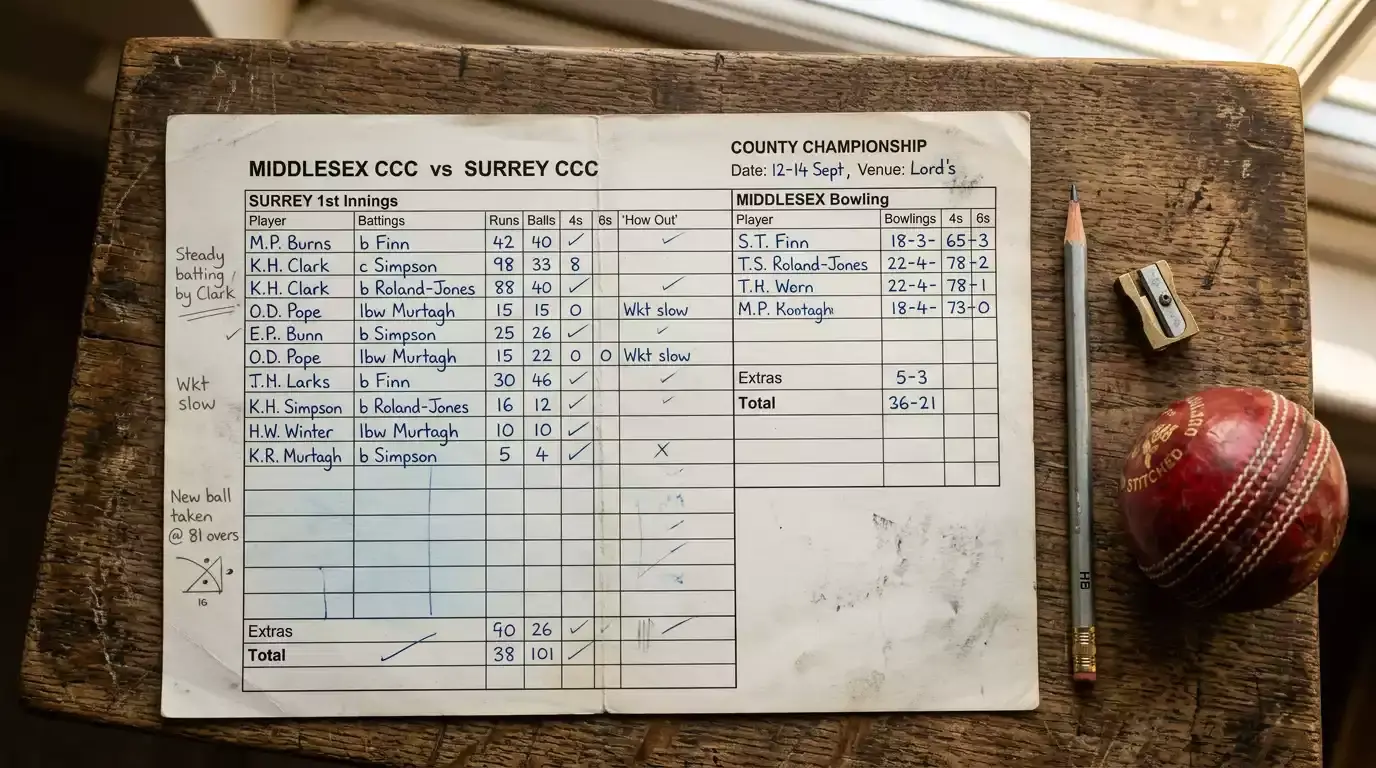
Open the cricket card on any UKGC-licensed sportsbook during a Vitality Blast double-header and count the markets. I did this last August on a Surrey vs Somerset fixture at The Oval and stopped at 184. Sportradar quietly mentions in its product literature that the firm prices "over 7,000 pre-match and live matches" of cricket each year — more than any other sport in its catalogue. That density is unique to cricket, and it is the reason punters who outgrow football tend to drift here and stay.
The whole landscape splits into three structural categories, and once you see them as families rather than as a flat list, the card stops feeling overwhelming.
| Family | When it settles | Typical examples | Best suited to |
|---|---|---|---|
| Pre-match | At the end of the match | Match winner, top batsman, top bowler, total match runs, method of first dismissal | Punters who do their work before play and prefer locked prices |
| In-play | During the match, often within minutes | Next over runs, next wicket method, partnership runs, session totals | Punters who can read momentum live and tolerate fast price decay |
| Outright | At the end of a tournament or season | County Championship Division 1 winner, Vitality Blast winner, World Cup top run-scorer | Long-horizon punters comfortable with capital tied up for weeks or months |
Pre-match contains the markets a casual reader recognises: match winner, top batsman, top bowler, total match runs, method of dismissal, toss winner. The toss is a special case priced near 50/50 with a small margin built in; the value, when it appears, is rarely in the price itself but in the conditional markets that move sharply once the toss outcome is known. Method-of-dismissal markets typically run with caught, bowled, LBW, run-out, stumped and "other" as discrete options, priced against base rates that vary by format and surface.
| Outcome | Fractional | Decimal | Implied % |
|---|---|---|---|
| Match winner: home side | 4/6 | 1.67 | 59.9% |
| Match winner: away side | 11/10 | 2.10 | 47.6% |
| Top match batsman: top-order anchor | 9/2 | 5.50 | 18.2% |
| Method of first dismissal: caught | 4/5 | 1.80 | 55.6% |
The implied probabilities sum to over 100 per cent — the difference is the operator's margin, often called overround or the vig.
Overround — the percentage by which the implied probabilities on a market exceed 100 per cent. A two-way market priced at 1.95/1.95 has an overround of around 2.6 per cent, the operator's theoretical margin if the book is balanced.
In-play is where cricket genuinely outpaces almost every other sport. Markets refresh ball-by-ball during the powerplay, between overs in the death, and after each wicket. Micro-bets now appear on most major UKGC cards during the Vitality Blast and The Hundred. They are profitable for a tiny minority of punters with genuine ball-by-ball reading skill, and a slow leak for everyone else.
Outright markets carry the longest planning horizons and the softest lines. County Championship outrights opened with Surrey as 7/4 favourites for Division 1 in 2026 and Durham 5/7 in Division 2; those prices reflect both genuine form and a thinner pool of money than a Premier League title market would attract.
I have walked through each market type in detail, with typical price ranges and the punter profile each suits, in the dedicated markets guide. For this pillar, the takeaway is that pre-match is for planners, in-play is for readers of live momentum, and outrights are for the patient.
Test, ODI, T20, The Hundred, Vitality Blast, County Championship: How Format Changes the Bet
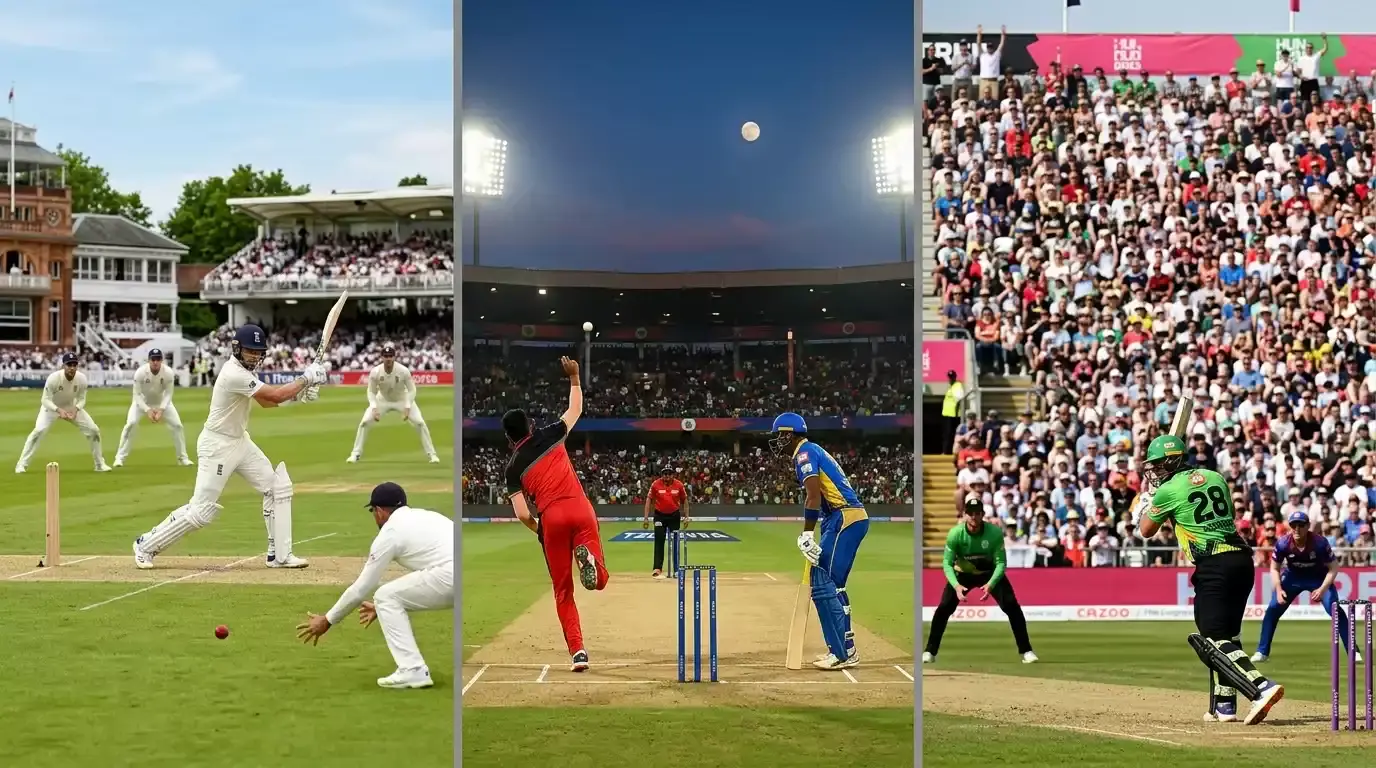
Somerset lifted the Vitality Blast trophy in 2025, their third T20 domestic title. The competition ran 18 teams across 133 matches between 29 May and 13 September. Toby Albert top-scored with 633 runs for Hampshire; Riley Meredith took 28 wickets for Somerset. Those four numbers — 18, 133, 633, 28 — are the kind of inputs a serious cricket bettor builds models around, and they tell you why format is not a footnote. Format is the variable that decides which numbers matter.
Test
Five days, two innings each, draw possible. Volatile late-innings totals; pitch deterioration as a primary variable. Match-result markets often include "draw" as a real outcome, which fundamentally reshapes pricing.
ODI
Fifty overs per side, one innings each. Powerplay overs front-loaded; death overs as a separate sub-market in their own right. Run-rate and partnership markets dominate.
T20 International
Twenty overs per side. High-variance batting, low-variance bowling allocation. Side that wins the toss and bowls first tends to be a small favourite under lights with dew.
The Hundred
100 balls per side, ten-ball "10s" instead of overs, max five balls per bowler in a single stretch. Newer market; bookmaker models less mature, soft lines on tournament outrights more common in early rounds.
Vitality Blast
Premier UK domestic T20. Long group stage, knockouts at the end of summer. The deepest UK domestic T20 data sample available.
County Championship
Four-day red-ball, two divisions. Outright winner, division winner, relegation, top run-scorer and top wicket-taker run all season. Lower liquidity, longer market memory, and the format where a careful UK punter is most likely to find soft pricing.
Format dictates which inputs carry signal and which are noise. In a Test match, day-five pitch behaviour and the second-innings collapse risk are the events that move match-winner prices most violently; in a T20, a six-over powerplay can do the same work in twenty minutes. A model that ignores format is not a cricket model, it is a betting hobby with a spreadsheet.
| Variable | Test | ODI | T20 |
|---|---|---|---|
| Match duration | 5 days | ~7 hours | ~3 hours |
| Draw available | Yes | No (tie possible) | No (Super Over) |
| Match-winner price volatility | Low until day 4, then high | Medium throughout | High throughout |
| Pitch effect on totals | Decisive | Material | Modest |
One UK quirk: county cricket is supported year-round by a multicultural audience with strong family ties to India, Pakistan, Bangladesh and the Caribbean, which keeps cross-format betting interest stable through the winter even when the domestic English game is dormant. A County Championship match in April and an India tour Test in December draw from overlapping pools of UK punters, and the cross-format know-how acquired in one feeds the other.
The format-by-format breakdown is in the formats deep-dive. The headline is that you should not run the same model across Test, ODI and T20 without recalibrating; the underlying generative process is genuinely different.
Reading UK Cricket Odds: Fractional, Decimal, Implied Probability
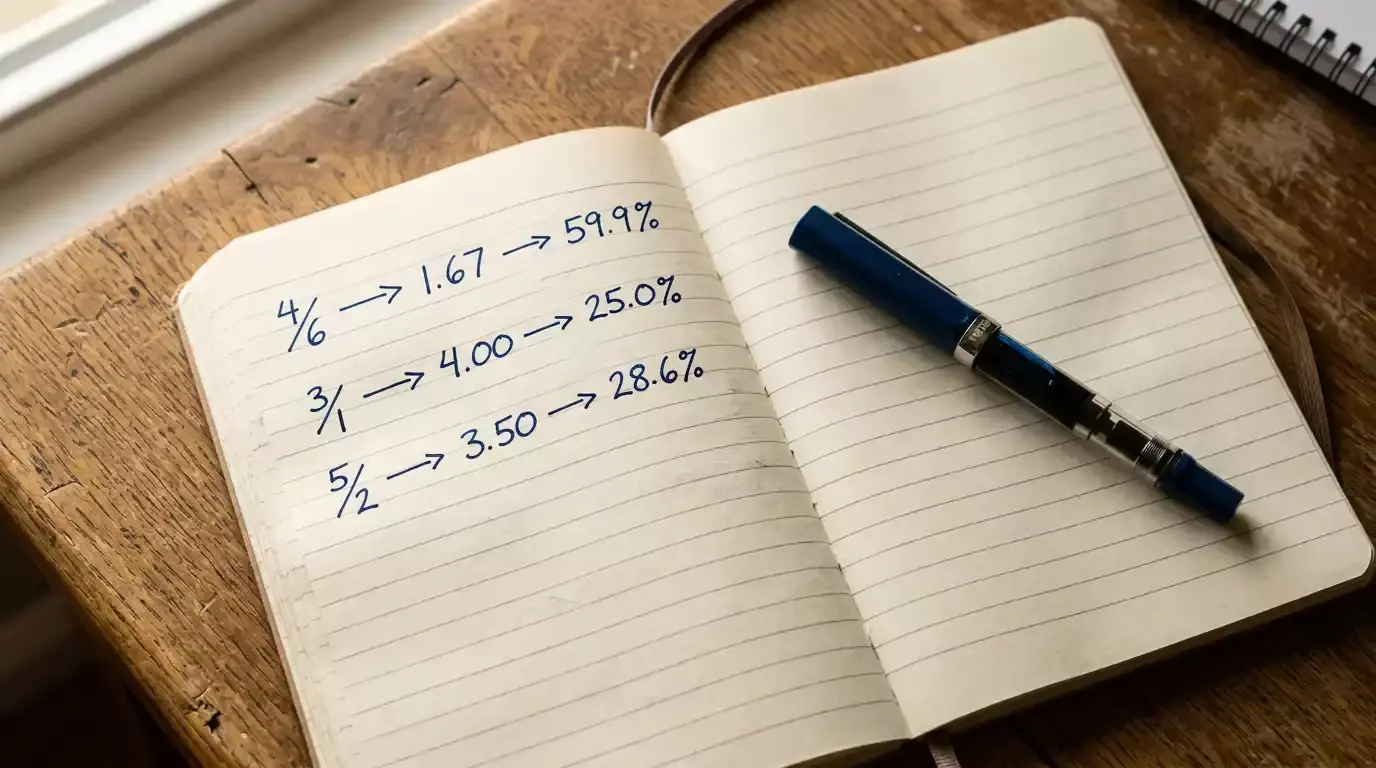
The first time I tried to explain fractional odds to a colleague who had moved over from a US sportsbook, she stared at me as though I had just suggested measuring batting averages in cubits. UK fractional notation looks archaic at first glance — 7/4, 11/10, 9/2, 5/6 — and it is. It is also the format every major UK book defaults to, every UK racing page prints, and every county cricket outright is quoted in. Learning to read it instantly is non-negotiable if you bet UK cricket markets.
Three numbers, one calculation, used a hundred times a season. That is the whole job.
Surrey 7/4 for the County Championship Division 1 title in 2026
Step 1 — Convert fractional to decimal. Decimal odds = (numerator ÷ denominator) + 1. Here: (7 ÷ 4) + 1 = 1.75 + 1 = 2.75.
Step 2 — Convert decimal to implied probability. Implied % = (1 ÷ decimal) × 100. Here: (1 ÷ 2.75) × 100 = 36.4%.
Step 3 — Read it. The bookmaker is implicitly saying Surrey win the title 36 times in 100 imagined seasons. If your own model thinks the true probability is above 36.4 per cent, the bet has positive expected value. If your model thinks it is below, the bet is a slow leak however much you fancy Surrey.
That is the entire conversion machine. Memorise the two formulas and the rest is arithmetic.
| Fractional | Decimal | Implied % |
|---|---|---|
| 5/6 | 1.83 | 54.5% |
| Evens (1/1) | 2.00 | 50.0% |
| 11/10 | 2.10 | 47.6% |
| 7/4 | 2.75 | 36.4% |
| 9/2 | 5.50 | 18.2% |
| 10/1 | 11.00 | 9.1% |
Two practical points that catch beginners out. First, fractional odds shorter than evens are written denominator-first: 4/6, 5/6, 4/9. These are odds-on, meaning you stake more than you stand to win in profit. A 4/6 price returns £6 profit on a £10 stake, plus your £10 back — total return £16, decimal 1.67. Second, "Evens" and "1/1" are the same thing and most UK cards just write "EVS".
The implied probability number is the one I keep returning to, because it is the language in which value lives. Every time you look at a UK cricket price, your job is to translate it into a probability and then compare that to your own estimate. The bookmaker's number is rarely badly wrong on a heavily traded market like an Ashes Test match-winner. On a soft outright market — a County Championship Division 2 winner, a women's Vitality Blast top run-scorer, a Hundred team finals position — the chance of finding a meaningful gap between the bookmaker's implied probability and a defensible estimate is materially higher.
Value, Edge, and Why Lower-Liquidity UK Markets Are Worth Watching

In my second year doing this for a living I lost money for ten months straight on Premier League match-result markets, then made it all back in four weeks during the Vitality Blast group stage. The lesson took a year to absorb properly: you do not find edge where the smart money already is. You find edge where the smart money is not yet looking, or has not bothered to look hard.
Value, in this game, is the difference between the bookmaker's implied probability and your own better estimate. Edge is what that gap is worth, multiplied across thousands of bets. The maths is unsentimental — a 2 per cent edge applied to a £100 weekly turnover returns £2 a week on average — but the practical question is where to deploy a finite amount of analysis time.
Sportradar quotes pricing over 7,000 pre-match and live cricket matches a year. The major UKGC books cover the meaningful slice of that catalogue — internationals, IPL, The Hundred, the Blast, the Championship and a handful of overseas T20 leagues — and the depth of money on a Saturday Vitality Blast double-header is genuinely large. Compare that to a Friday afternoon County Championship Division 2 fixture being played in front of three dozen people at New Road. The bookmaker has priced it. The money sitting against that price is a fraction of what is on the Blast.
Liquidity is not glamour. The Friday afternoon Division 2 game is where soft lines live, because operator traders have less reason to refine them, less in-running flow to discipline them, and fewer market-making competitors keeping them honest. That is where I have made most of my returns over eight years.
This is also why UK domestic cricket is genuinely interesting for a UK punter — and why the same UK punter rarely beats the IPL outright market. The IPL is priced by the same global model the rest of the world is hammering. The Championship is not.
The full apparatus of value betting — pricing your own model, sizing stakes with the Kelly criterion, tracking closing line value as your truer signal of skill than P&L — sits in the value-betting strategy guide. For this pillar: edge exists more reliably where bookmaker attention is lower, and translating fractional odds into implied probability is the first habit that makes finding edge possible.
In-Play, Cash Out, Micro-Bets: How Live Cricket Betting Works in 2026
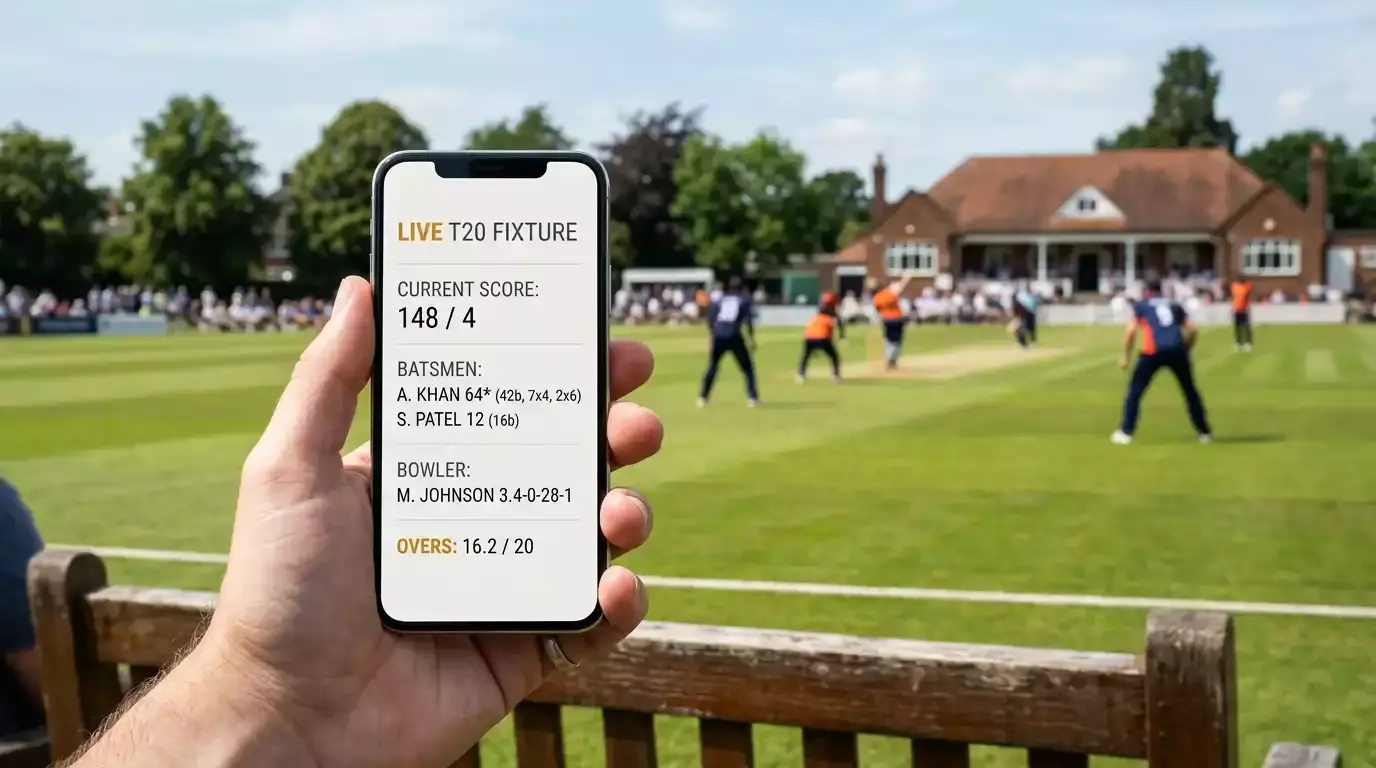
Ninety-five per cent of UK online gambling happens from home. The lounge sofa, not the betting shop, is now the central venue for UK cricket betting. That single statistic explains the modern in-play product more directly than any operator marketing deck — when a Vitality Blast Saturday-night thriller is on Sky, the second screen beside the punter is where wagers happen, ball by ball.
In-play markets refresh continuously. Next-over runs ticks within seconds of the previous ball. Match-winner odds swing twenty percentage points either side of an over in a tight T20 chase. Wickets, partnerships, methods of dismissal, session totals — each is a separately priced micro-market that opens, prices, and settles within minutes.
Cash out is an operator-offered facility to settle an unresolved bet early at a price derived from current market state. If you backed Surrey at 7/4 and the side is now 1/3 favourite mid-season, the cash-out figure offers less than your potential return — implied current probability minus an additional operator margin. It is a convenience product, not a value-positive one; over the long run it costs expected value compared with letting the bet run.
Micro-bets are the fastest-growing slice of in-play, and the slice I would caution a recreational punter on most. The settlement window is so short that no model edge of meaningful size survives the bookmaker's margin. Where they make sense is as entertainment — a £1 ball-by-ball engagement rather than a profit centre.
The single largest in-play structural risk is not a price one. Live markets reward speed of reaction over depth of analysis, which inverts the skill set most thoughtful punters bring to pre-match work. There is no substitute for testing the question on a paper bankroll first, across at least a full Blast group stage.
Dew factor — in evening matches at venues that retain moisture, dew settles on the outfield during the second innings and makes the ball harder to grip. The side bowling second is at a measurable disadvantage. International fixtures at Edgbaston or The Oval under lights can show the effect, and the in-play match-winner price on the bowling-second team frequently fails to fully discount it.
Bet builder has changed the recreational landscape most over the last three seasons. You stack three to six selections from a single match — top batsman X, top bowler Y, match runs over Z, side X wins — and the operator's correlation engine prices the combined parlay. Correlations between cricket events are stronger than in most sports, which gives the bookmaker pricing power and gives a sharp punter a target. Like outright markets, bet builder is a place where soft pricing genuinely does appear.
Integrity in 2025: Sportradar Data, ECB Code, the Cricket Regulator
Sixty-eight matches. That is the rough number cricket needs to produce in a year to count as a "low" integrity year by recent standards. In 2025 it produced 59 suspicious matches by Sportradar's count — which is, paradoxically, the headline that ought to worry you most. Sportradar's official wording is that cricket "more than tripled any of the previous year's levels dating back to 2021".
1,116
suspicious matches flagged globally across all sports by Sportradar in 2025, down 1 per cent on 2024
59
of those 1,116 were cricket — a near-tripling of any year-on-year baseline since 2021
+56%
increase in suspicious matches detected by Sportradar's UFDS AI system, from 436 in 2024 to 682 in 2025
Two readings of those numbers are circulating. One is that cricket has a real, growing integrity problem; the other is that the detection apparatus is getting sharper faster than the underlying fix rate is changing. I lean towards the second. Sportradar monitored more than a million events in 2025 and judged 99.5 per cent of them free from suspicion, consistent with a sport where the overwhelming majority of professional matches are clean and a small criminal periphery is being squeezed harder by better tools.
The UK has built its institutional response around three pillars: the ECB Code of Conduct on Gambling Sponsorships introduced at the start of the 2025 season, the ECB Cricket Regulator launched as an independent body in 2023, and the ICC Anti-Corruption Unit working internationally. Sportradar's Integrity Education programme reached more than 34,000 participants in 2025, up 25 per cent.
The ECB Code rests on four principles applied to every Professional County Club and Hundred franchise: reinvestment of sponsorship value back into the sport; integrity safeguards on counterparties; social responsibility messaging; and a fourteen-day mandatory reporting window for any new commercial deal. Only operators holding a UKGC operating licence — or a valid white-label UK partnership — are eligible counterparties.
The Cricket Regulator has shifted English cricket's integrity posture most. Spun out of the ECB in 2023 and headed by Dane Lewis, a former police chief with more than thirty years of service, it covers anti-corruption, anti-discrimination, doping and conduct violations, and runs separately from the commercial side of the ECB to preserve investigative independence.
UK-specific 2024-2025 cases — Brydon Carse's three-month ban for betting offences and Mugheez Ahmed Sheikh's five-year ban for an attempted approach to a county coach — are the events most UK punters will have seen referenced without the regulatory framework behind them. The detail is in the integrity deep-dive.
Why the Offshore Black Market Is the Single Biggest Risk to a UK Cricket Bettor

Every few months a reader asks whether site X — usually a slick offshore operation advertising on a third-rate sports streaming page — is "basically the same" as a UKGC-licensed site. The answer is no, and the gap is widening in a way that should worry any UK cricket punter who wants their winnings to land in a UK bank account.
The numbers have escalated past anything the industry expected. Yield Sec's H1 2025 work for the Campaign for Fairer Gambling put illegal operator revenue from UK consumers at £379 million for the first half of 2025 alone, with offshore share of the UK online market rising from 0.43 per cent in 2020 to roughly 9 per cent in H1 2025. H2 Gambling Capital estimates UK consumers placed approximately £16.6 billion in stakes on black-market platforms across 2025 — more than three times the £5 billion figure for 2019. The legal market's share of total UK gambling activity fell from 97 per cent in 2019 to 92 per cent in 2025.
£379m
illegal operator revenue from UK consumers in H1 2025 alone
531
black-market sports betting and casino operators actively targeting UK audiences in H1 2025
1.6bn
illegal stream views across the UK top-ten sports in H1 2025, on track to surpass the 3.1 billion full-year figure for 2024
Ismail Vali at Yield Sec laid out the scale bluntly: "The illegal sector comprises around 700 unlicensed operators promoted by more than 1,600 affiliates, operating alongside the legal market of over 2,000 licensed operators generating £3.9bn in revenue." Two roughly comparable infrastructures, one with zero consumer protection. WARC forecasts black-market bookmakers will spend roughly £1 billion on UK gambling advertising by 2028 — more than the regulated sector.
What an offshore site costs a UK cricket punter is not abstract. There is no UKGC complaints route, no GamStop coverage, no statutory levy contribution, no regulatory backstop if the site refuses to pay out, and the tax-free status of UK gambling winnings does not survive a transaction outside a UK-licensed operator.
Derek Webb at the Campaign for Fairer Gambling has been blunt about who uses the offshore alternative: "There is no good reason for mainstream consumers to use illegal gambling operators, so crime targets only those consumers who have bad reasons for requiring illegal gambling operators: they are under 18 and they are on the GamStop self-exclusion scheme."
The practical defence is short. Stay with UKGC-licensed operators. Verify the licence number on the Gambling Commission register, not the operator's own footer. If something on a sports site looks too good — the welcome offer, the unlimited stakes, the absence of any ID check — it almost certainly is.
Responsible Betting: Affordability Checks, GamStop, Deposit Limits, PGSI

A friend who has been a county cricket member at The Oval for two decades asked me last winter whether he was a "problem gambler" because he had spent more on cricket bets than on his Surrey membership. The honest answer was that the question itself was the healthy thing — the people who never ask are the people the industry actually worries about.
Problem gambling affects roughly 0.5 per cent of UK adults, or around 340,000 people. A further 1.8 million carry a PGSI score of 1 or higher — the "at-risk" band. The NHS has logged a 34 per cent rise in presentations for gambling treatment between 2019 and 2024. GambleAware research from November 2025 estimates more than five million UK adults want to cut down or stop gambling altogether, and more than one million carry a PGSI score of 8 or higher.
PGSI — the Problem Gambling Severity Index, a nine-item self-report screen. Scores of 1-2 are "low risk", 3-7 "moderate risk", 8+ "problem gambling". The screen is the basis for the UKGC prevalence estimates and the most widely cited harm metric in UK datasets.
Among 16 to 24-year-olds the picture is sharper. Twenty-nine per cent of young people in 2025 reported seeing a family member gamble, up from 26 per cent. Among young people who themselves gamble, the rate of PGSI 8+ is 19 per cent, against 6 per cent for adults who bet. The £2-per-spin slot cap for 18 to 24-year-olds reflects that data directly.
Do
- Set a deposit limit on every UKGC-licensed account at the lowest level you can realistically operate with.
- Treat the £150/30-day affordability check as a feature — a signal someone is paying attention.
- Keep a written record of stakes, returns, and time spent.
- Use GamStop if you need a hard stop — 6 months, 1 year, or 5 years across every UKGC-licensed operator.
Don't
- Chase losses with stake size increases — variance maths punishes this faster than instinct expects.
- Use multiple accounts to bypass a single-operator deposit limit.
- Treat in-play and micro-bets as a "small fun" category when cumulative monthly volume is significant.
- Engage with an offshore site to escape a UK-licensed restriction.
GamStop has registered more than 600,000 users since 2018. One registration covers every UKGC-licensed online operator; self-exclusion blocks new wagering for the duration chosen. It is one of the more effective harm-reduction tools the UK system has produced, and it is free at the point of use.
The affordability check, in practice. Triggered at £150 net deposit across a rolling thirty-day window with a single operator, using public credit reference data — not bank statements or open banking. For most UK cricket punters it is invisible and one-off. For a smaller cohort the operator will request more information.
The 2025 package is genuinely more protective than what came before, and the burden of using it is light for any UK cricket bettor operating well within their means.
A Pre-Bet Workflow That Survives a Full Season

The single most useful thing I built in my third year on this beat was not a model. It was a checklist. A friend who flies commercial 737s pointed out that pilots run cockpit checklists not because they cannot remember the procedure but because under pressure even experts forget steps in predictable patterns. Betting under match-day pressure is identical in form, if not in stakes.
The list below is what I run on every bet now, pre-match or in-play, before any stake leaves the account. It takes about ninety seconds once the habit is built and it has prevented more red days in the last four years than any model upgrade I have made.
Pre-bet checklist for UK cricket markets
- UKGC licence on the operator verified against the Gambling Commission register.
- Pitch report read for the venue — surface, recent scores at the ground, batting/bowling first wash.
- Weather and dew checked, especially for floodlit T20 fixtures.
- Both lineups confirmed, not predicted; toss outcome known before any first-innings runs market.
- Bookmaker's implied probability calculated from the displayed price.
- Own estimated probability written down before looking at the price.
- Stake within pre-set per-bet limit and within monthly deposit limit.
- Bet does not depend on cash-out behaviour to be acceptable — cash-out is an exit, not a plan.
Writing down your private probability before looking at the price is the item most punters skip and the one with the largest measurable effect on results. Anchoring to the bookmaker's number is the default human behaviour, and it eats edge invisibly. If your private estimate of Somerset to win a Vitality Blast quarter-final is 58 per cent and the operator's price translates to an implied 54 per cent, that is a real four-point edge. If you only ever look at the price first, you will rationalise your estimate towards it within seconds.
A representative end-to-end pre-bet sequence
Fixture: County Championship Division 1, Surrey vs Lancashire at The Oval, day three. Bet: Surrey to win.
Bookmaker price: 4/6 fractional. Decimal = (4 ÷ 6) + 1 = 1.67. Implied probability = 1 ÷ 1.67 = 59.9 per cent.
Personal estimate, written down first: Surrey 64 per cent.
Edge: 64% − 59.9% = 4.1 percentage points.
Stake sizing: 1 per cent of bankroll. On a £2,000 bankroll, £20.
Expected return: 64% × £13.40 profit − 36% × £20 loss = £8.58 − £7.20 = £1.38 per bet on average, assuming the personal estimate is correctly calibrated. The model has to be right, not the bet.
The workflow does not promise winning bets. It promises that the bets you do place will be the ones you would still endorse on a Tuesday morning with a coffee, not the ones a Saturday night in front of Sky Sports talked you into.
What the People Who Watch the Market Are Saying
Three voices have shaped how I think about the state of UK cricket betting in 2026, and each one tackles a different corner of the same picture. None of them is a punter. All of them are watching the industry from a vantage point most of us never get to occupy.
The first is Andreas Krannich, Executive Vice President of Integrity Services at Sportradar, on what the 2025 figures actually mean. "The relative stabilisation of suspicious match numbers in 2025 is encouraging, yet it reinforces the importance of continued vigilance. Match-fixing remains an evolving threat, and sustained investment in technology, intelligence, education, and collaboration is essential to staying ahead of those seeking to corrupt sport." The point Krannich is making, read carefully, is that flat-or-falling top-line numbers do not signal the threat has receded. They signal the detection apparatus has caught up to a moving target.
The second is the ECB itself, in its launch statement for the 2025 Gambling Sponsorship Code. "The Code of Conduct signifies a strong commitment to balancing commercial partnerships with gambling companies while protecting the integrity of cricket. By reinforcing responsible sponsorship practices, the code seeks to safeguard both the sport and its community from potential gambling-related risks." The framing matters because the ECB chose not to ban gambling sponsorships outright — a real option discussed during the consultation. The Code keeps the commercial relationship intact and places the burden of responsibility on its terms. Whether that balance holds through the 2026 and 2027 county seasons is the open question.
The third is Grainne Hurst, CEO of the Betting and Gaming Council, on the policy logic of the 2025 reforms. "The choice for policymakers is clear. If the regulated sector becomes harder to use or less competitive, customers will not stop betting, they will simply go elsewhere." That observation is uncomfortable for any regulatory enthusiast, but the offshore numbers in the previous section bear it out. The 9 per cent share of UK online activity now sitting offshore is the empirical answer to Hurst's question, and the trajectory of that share is the variable the next phase of UK gambling policy has to grapple with.
Reading the three statements as a single set: detection is winning, the institutional response is hardening, and the regulatory perimeter is leaking. A UK cricket punter in 2026 lives inside that triangle.
Cricket Betting Queries from UK Punters
Is cricket betting legal in the UK in 2026?
Yes, provided the operator holds a UK Gambling Commission operating licence. UK residents pay no personal income tax on betting winnings. Offshore operators without a UKGC licence cannot lawfully accept UK customers, and using them puts winnings, complaints rights, and consumer-protection access at material risk.
Which formats and tournaments form the core of the UK cricket betting calendar?
The pillars are international fixtures involving England — the Ashes is the largest single event by handle — and the domestic competitions: the County Championship, the Vitality Blast, and The Hundred. The Vitality Blast 2025 ran 18 teams across 133 matches, won by Somerset. The County Championship 2026 starts on 3 April with Surrey at 7/4 in Division 1 and Durham at 5/7 in Division 2. IPL, ICC tournaments and the World Test Championship round out the calendar.
How do fractional and decimal odds relate to implied probability?
Decimal odds equal (fractional numerator divided by fractional denominator) plus 1. Implied probability as a percentage equals (1 divided by decimal odds) multiplied by 100. Worked through Surrey at 7/4: (7 ÷ 4) + 1 = 2.75 decimal; (1 ÷ 2.75) × 100 = 36.4 per cent implied probability. A bet has positive expected value when your own probability estimate exceeds that figure by more than the operator's margin.
What changed for UK bettors in 2025 — statutory levy, stake limits, affordability checks?
The statutory gambling levy came into force on 6 April 2025, charging online operators 1.1 per cent of GGY, targeting £90 to £100 million a year by 2027. Online slot stake limits of £5 per spin for 25+ and £2 for 18-24 took effect through 2025. Affordability checks under SRCP 3.4.4(6) trigger at £150 net deposit over a rolling thirty-day window. The third is the one a UK cricket punter is most likely to notice.
How serious is match-fixing in cricket right now, and what does the data say?
Sportradar flagged 1,116 suspicious matches across 70 sports in 2025, a 1 per cent decrease on 2024. Cricket accounted for 59 of those — more than tripling any baseline since 2021. UFDS AI detection rose 56 per cent year-on-year, from 436 to 682, and 99.5 per cent of monitored events were free from suspicion. The pattern is consistent with better tools catching a relatively stable problem. The 2024 Brydon Carse three-month ban and the 2025 five-year ban on Mugheez Ahmed Sheikh are the UK cases that defined the period.
What is the difference between a UKGC-licensed sportsbook, an exchange, and an offshore site?
A UKGC-licensed sportsbook prices markets itself and takes the other side of every wager. An exchange matches one customer's back with another's lay and takes a commission on net winnings. Both sit inside the regulatory perimeter — affordability checks, GamStop, levy, complaints route, tax-free winnings. An offshore site does none of these. Yield Sec put illegal operator revenue from UK consumers at £379 million in H1 2025 alone.
Where to Go Next
This pillar covered the UK cricket betting landscape end to end: the market, the law, the structure of bets, the integrity picture, the black-market risk, and the responsible-betting toolkit. The cluster articles take each pillar section into operational depth. Read the markets piece if you want every line on a Saturday card explained. Read the strategy piece if you want the value-betting and edge-pricing apparatus laid out properly. Read the regulation piece if you need the 2025 reforms in full detail. Read the integrity piece for the UK cases. Read the formats piece for the model recalibration each competition requires.
