


Strategies for County Championship Season Outright Bets
The County Championship is the longest-running professional sports competition in the UK calendar, and the betting markets around it are designed for the length. Single-match red-ball outright pricing is thin and inconsistent — most county fixtures don’t draw the daily attention that produces tight match-by-match pricing. The outright markets are the route in. Title winner, wooden spoon, promotion, relegation, top run-scorer of the season — these are the products UK regulated sportsbooks lean on to engage punters with five months of red-ball cricket, and they’re where the realistic edge lives if you’re willing to think long-form.

Sportradar’s product page describes its cricket odds coverage as “over 7,000 pre-match and live matches a year, with the industry’s highest GGR for cricket”. The Championship is part of that footprint, but its match-by-match volume sits at the lower end. The outright markets compensate — they aggregate the season into a single tradable product that maintains live pricing across the full five months and rewards punters who do the structural homework.
Surrey 7/4 Favourite in Division 1: How the Line Got There
The 2026 Championship opens with Surrey priced at 7/4 in fractional odds as Division 1 favourites. The implied probability of that price is roughly 36 percent — Surrey are favoured but not dominantly so, and the book has built in real respect for the rest of the division. The price reflects Surrey’s strong recent record, their squad depth, and their financial muscle as the largest county by membership and revenue. It also reflects the book’s awareness that a long red-ball season can punish even the strongest squad through injuries, weather and the cumulative effect of fixture density.
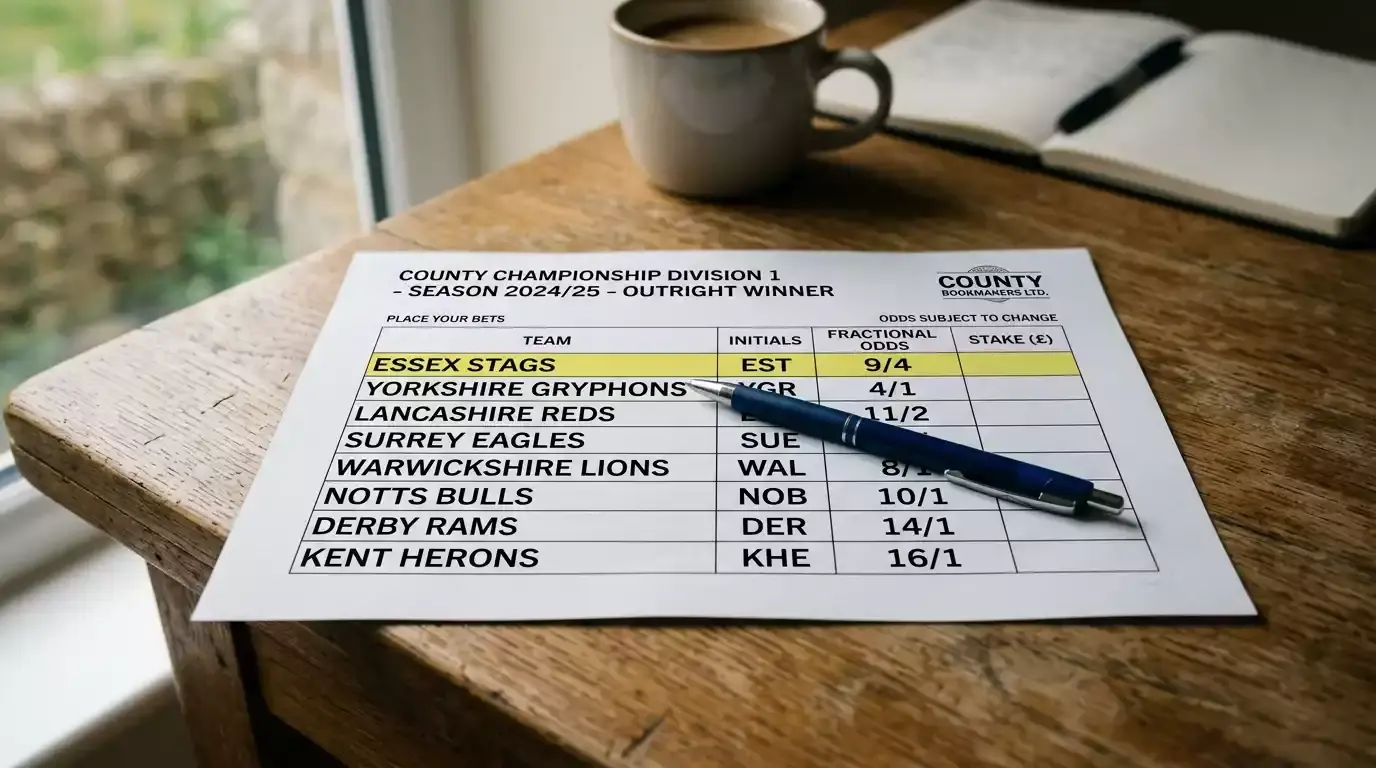
The price didn’t open at 7/4. Typical opening lines for a known favourite in a 10-team Division 1 sit at around 5/2 to 11/4, then tighten as squad announcements and pre-season form indicators come in. By the time the season starts in early April, the favourite price has typically compressed to around 6/4 to 7/4 if no major news has emerged, with the rest of the field spread between 4/1 for the credible challengers and 33/1 for the rank outsiders.
The structural mispricing in title markets often lives in the second and third favourites. Books over-anchor on the headline name and underprice the next tier. A side priced at 5/1 with comparable squad strength and a more favourable run of early fixtures than the favourite is often the better expected-value bet, even if the book’s implied probability for them is meaningfully lower. The 7/4 on Surrey isn’t structurally wrong, but it isn’t where the value lives either.
Durham 5/7 in Division 2 and the Promotion Race
Division 2 of the 2026 Championship has Durham as favourites at 5/7 in fractional odds, an implied probability of around 58 percent. The price is much shorter than the Division 1 favourite because Division 2’s competitive shape is typically more compressed at the top — a clear dominant side emerges more often than in Division 1, partly because the talent gap between the strongest second-division side and the relegated former Division 1 side is wider than the equivalent gap at the top of Division 1.
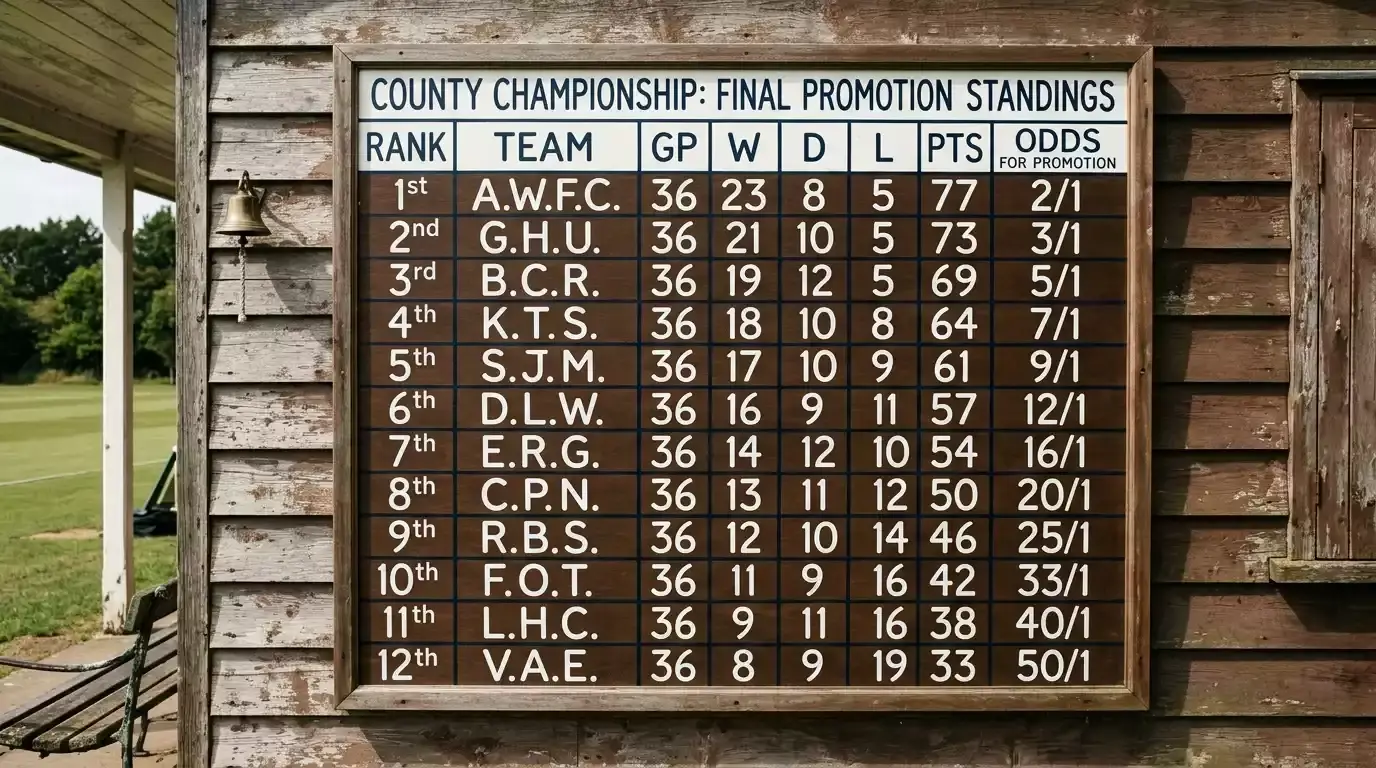
The promotion market sits alongside the title market in Division 2 and pays out on the top two finishers. A typical structure is “Durham to be promoted” at around 1/4, reflecting both the 5/7 title price and the secondary place for the runner-up promotion spot. The mathematics of “title plus second equals promoted” means promotion prices for the strong favourite are always shorter than the title price alone, but the place market for the second promotion spot is where the more interesting trading lives.
For a punter looking at Division 2 promotion markets, the second favourite typically prices at 11/4 or 3/1 for title, with “to be promoted” at around 5/4 to 7/4. The promotion-only bet on the second favourite is often better expected value than either the title bet on the favourite or the title bet on the second favourite, because it captures the realistic upside of finishing second without paying the premium for winning the division outright. “We aim to provide the industry’s highest GGR for cricket, with over 7,000 pre-match and live matches a year,” Sportradar Odds writes on its product page — and the depth of that pricing infrastructure is what enables the multi-market structure that creates these relative-value opportunities.
Wooden Spoon Markets: Pricing the Last-Place Race
The wooden spoon market — last place in the division — is one of the more interesting structural markets in Championship cricket because the dynamics that produce a wooden spoon are different to those that produce a title. Title contenders need consistent excellence across the season. Wooden spoon contenders need consistent dysfunction — long-term injuries, an underperforming new-ball pair, a coaching transition during the season, financial constraints limiting overseas recruitment.

Books price wooden spoon markets carefully because the favourite for the spoon is often a side that’s only marginally weaker than the next-weakest. A typical Division 1 wooden spoon market might have the favourite at 11/4 or 3/1, with the next two or three sides clustered at 4/1 to 6/1. The compression of the prices reflects how much uncertainty there is about which of the weaker sides actually finishes bottom.
The value in wooden spoon markets often sits at the third or fourth favourite — a side that punters and bookies have written off as “mid-table at worst” but whose schedule, squad and conditions point toward a difficult season. Identifying these requires deeper homework than identifying title contenders, partly because the public attention is on the upper half of the table and the bottom half is under-covered. For a patient punter willing to do the work, wooden spoon markets at 6/1 to 10/1 on a structurally weak side are some of the better-value bets on the Championship card.
Each-Way Rules and Place Fractions in County Outrights
Each-way betting on Championship outrights operates on the standard place-fractions structure that UK sportsbooks apply across racing and other outright markets. The specific rules vary by market and by operator, but the typical Division 1 each-way structure pays the win component on a title finish and the place component on a top-three or top-four finish, depending on the operator’s terms for that specific market.

Place fractions are typically a quarter or a fifth of the win price for the place component. A 5/1 bet each-way at quarter odds on the place pays out the win component on title plus a 5/4 return on the place component for the place finish. Stake matters — each-way is one bet at twice your stake, so a £10 each-way bet costs £20 in total, with £10 on the win and £10 on the place.
The place-fraction structure is where books differentiate themselves on outright markets. Some operators offer enhanced place terms — for example, paying three places at a fifth on Division 1 markets that would normally pay two places at a quarter. The enhanced terms shift the expected value of each-way betting meaningfully, and identifying which book offers the best each-way structure on a specific outright is one of the practical pieces of homework before committing to a long-dated bet.
Staking Strategy for a Multi-Month Outright
A title outright bet on a Championship campaign locks up your stake for five months. The capital management implications matter. A punter staking 5 percent of their bankroll on a single Championship outright at 5/1 is committing that 5 percent for the whole season, with no ability to redeploy it if a better opportunity emerges in May or June.
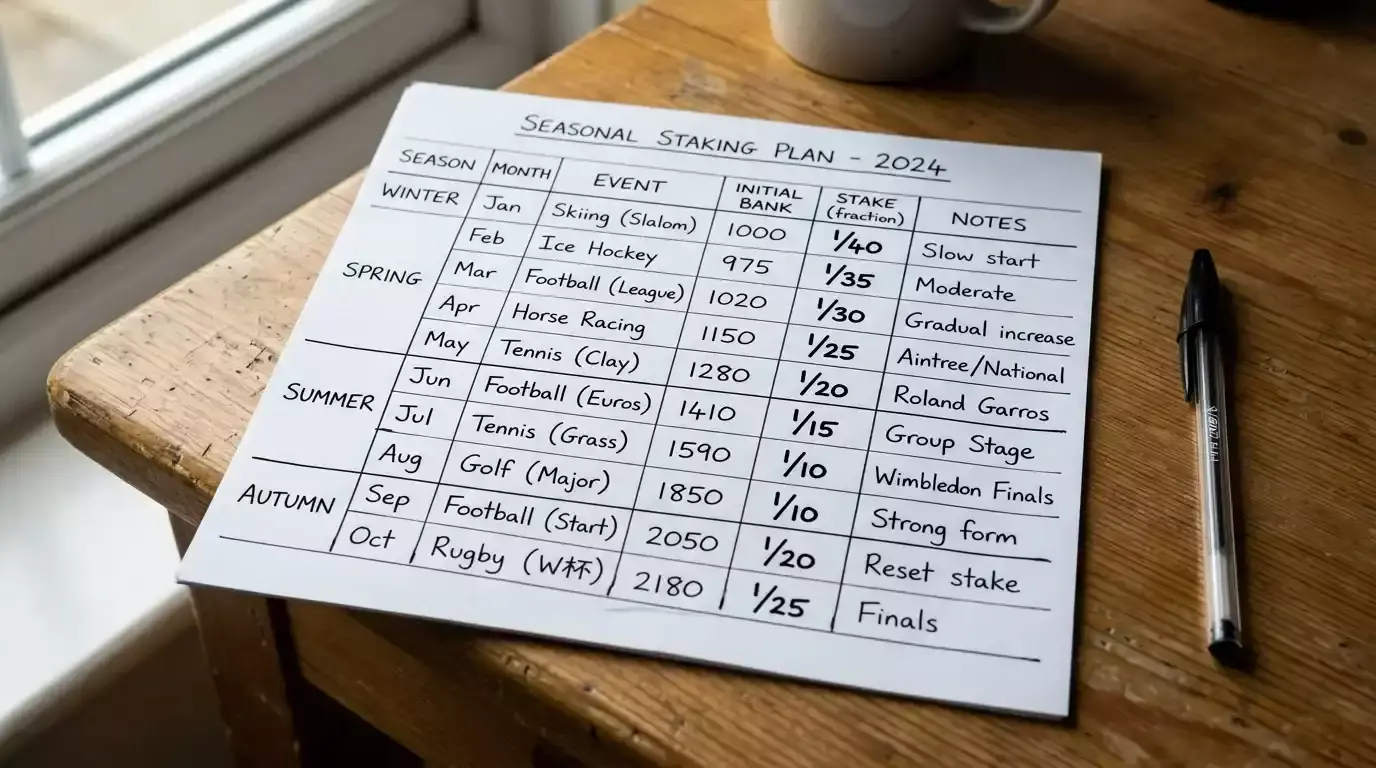
The disciplined approach is to fragment outright stakes across multiple markets — title, promotion, top run-scorer, top wicket-taker — at smaller stake sizes per market, rather than concentrating into a single big bet on a title. The diversification reduces the variance of seasonal outcomes and means individual market-specific drift doesn’t damage the overall position too heavily. A bankroll allocation of, say, 8 percent across four Championship outrights at 2 percent each is more robust than 8 percent on a single title bet.
The other disciplined practice is exchange-based hedging once the position has moved. If your title bet on a 5/1 outsider in March looks like a winning position by July, the exchange will let you lay the same side at much shorter odds to lock in profit. The cost of the lay — the commission and the residual margin between the back and lay prices — is the price of removing tail risk from the position. For long-dated outrights, this is often the rational endgame even if you remain bullish on the underlying outcome.
The wider seasonal context for Championship outrights sits within the year-round cricket calendar that I cover in my piece on the UK cricket betting calendar and its lack of a real off-season.
